One plan, sized to your race.
Drop in the athlete guide. We read it and turn it into a race-week plan: what to pack, which bag it goes in, where to be and when. A sprint gets five lines. A destination Ironman gets four days.
Free for your first upcoming race. No card needed.
5 events · 1 race-ending cut-off
Sun 14 Jun · 750 m / 20 km / 5 km
Red is a race-ending cut-off. Bold is a firm act-by time. Grey is context.
Three steps to a plan you'll trust at 4am.
Everything RackSide lines up is yours to confirm — nothing’s trusted until you say so.
Find your race
Most races are already on the calendar — pick yours and the plan is ready. Not there yet? Drop in the athlete guide and RackSide reads it for you.
Confirm what's yours
RackSide lays out your bags, venues and deadlines. Anything it’s unsure of comes as a calm “confirm?” — skim it, fix what’s off, and it’s set.
Work the plan
One sequenced, deadline-aware plan: which bag, where to be, and when. Tick each move as race week comes together.
One race, three moments.
Real screens from a 70.3 weekend: the week laid out, the night you pack, and race morning.
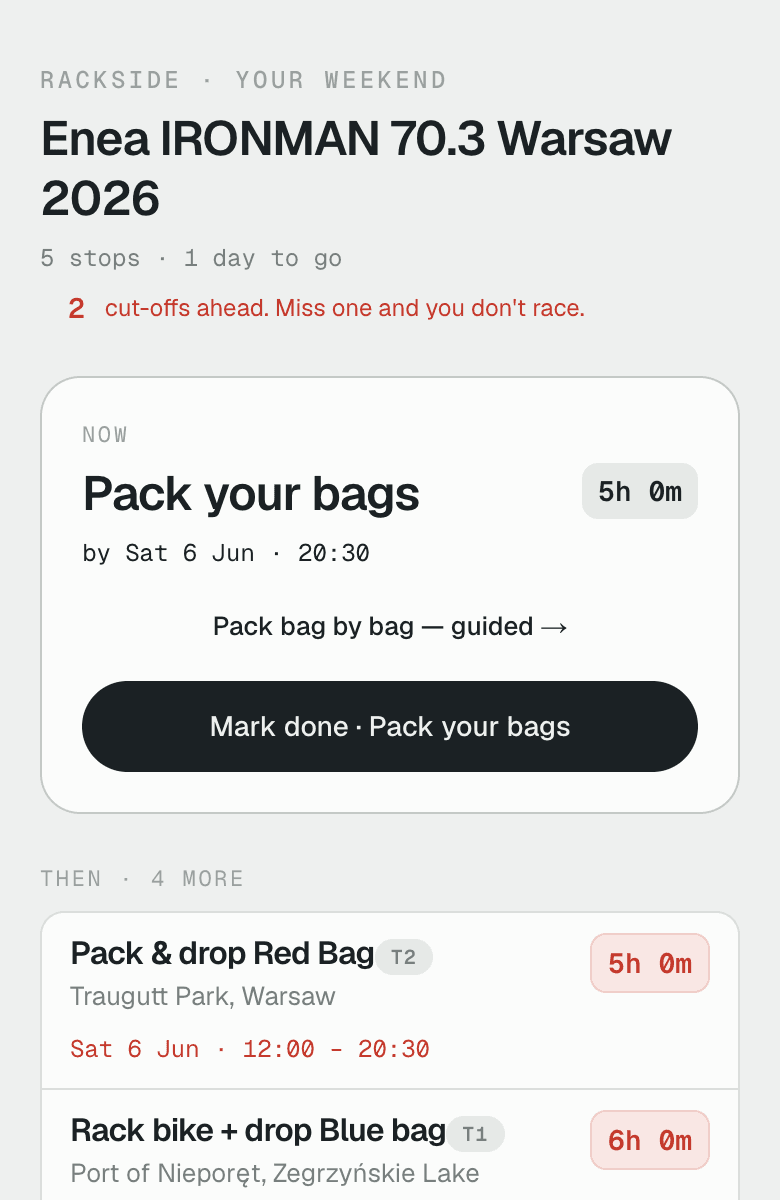
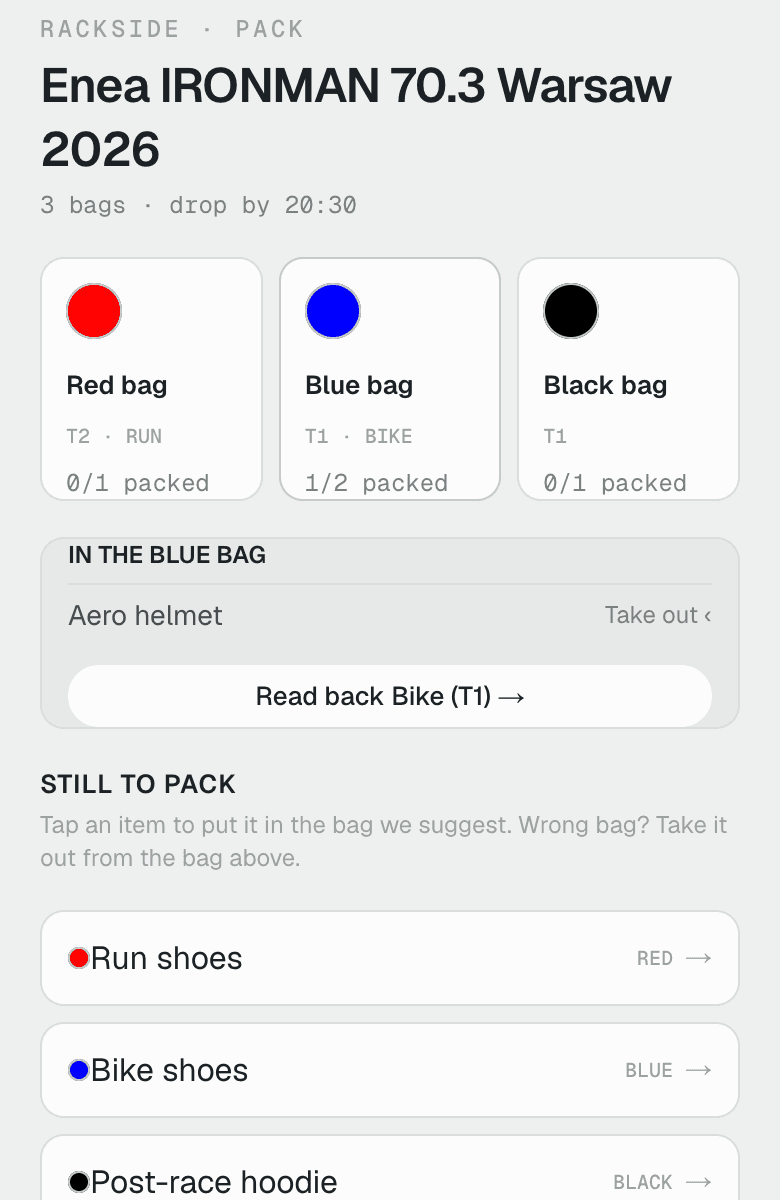
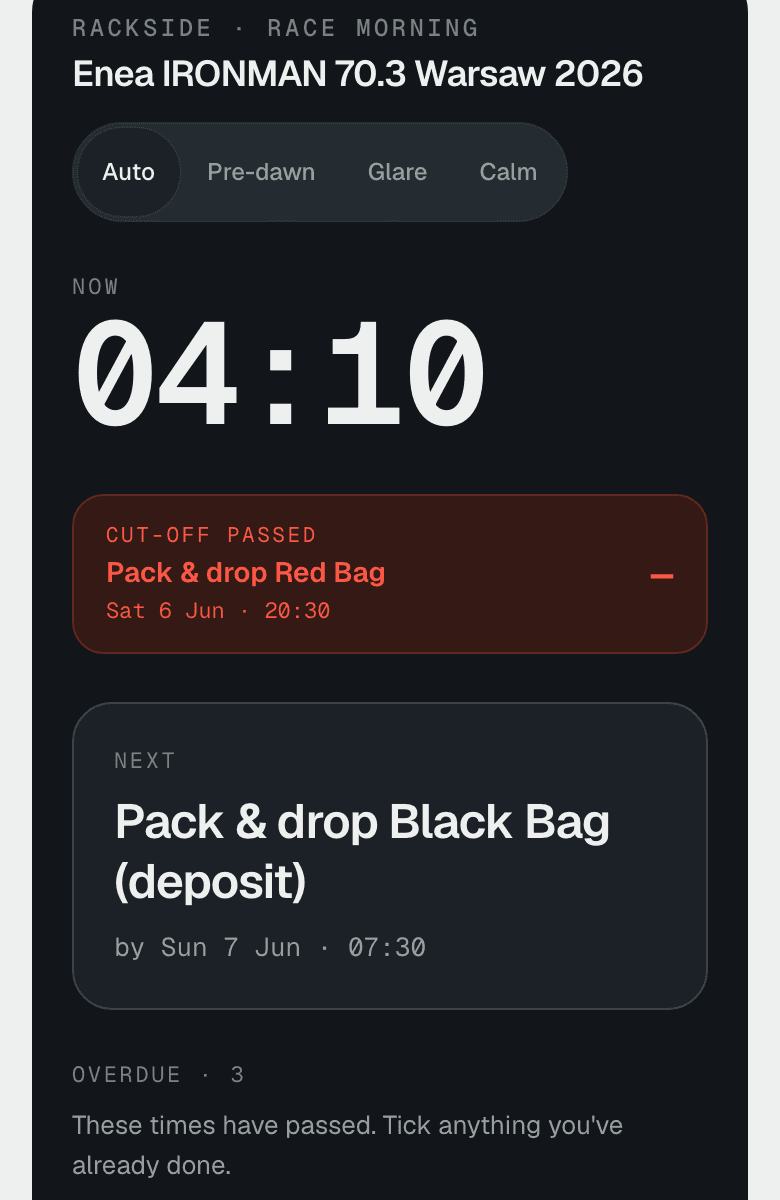
As much plan as your race needs — and no more.
A sprint collapses to a plan that feels complete. A destination Ironman fans out to its full staged sequence. Same plan, rendered to fit.
feels complete
No bags, no special needs — nothing greyed out.
fans out
Two things RackSide will never blur.
A deadline is a fact. We treat it like one.
Stated rules and hard cut-offs stay visually distinct from recommendations. A red deadline is something the race decided — miss it and you don't race.
When we’re unsure, we ask — calmly.
Anything we inferred from your guide is surfaced as a first-class “confirm?”, not an error. No red alarms for our uncertainty. You confirm; it becomes ground truth.
Triathlon transitions, bags and race week — answered.
The questions athletes actually search the night before. Generic logistics; your guide fills in the specifics.
Got your race in mind? Add your race and RackSide maps the bags and deadlines for you.
Or read what to pack for your race — one guide per race on the calendar, bags and check-in laid out.
In a typical long-course (70.3 / full Ironman) bag system, your blue bag is T1 — swim-to-bike: helmet, bike shoes, sunglasses, race belt, socks. Your red bag is T2 — bike-to-run: running shoes, hat or visor, run nutrition. A separate dry / street bag holds the clothes you arrived in and want back after the swim. Colours and exact contents are set by each race's athlete guide — always confirm against yours.
T1 is the first transition — swim to bike. You exit the water, find your rack spot, swap the wetsuit for helmet and bike shoes, and head out on the course. T2 is the second — bike to run: rack the bike, change into running shoes, start the run. Transition areas open and close at fixed times set by the race; miss the close and you can't rack, so those deadlines matter more than the packing.
Long-course races use colour-coded bags so volunteers can move them between transition zones. Most commonly blue = T1 (bike gear), red = T2 (run gear), and a third colour is the dry / street bag. The mapping varies by race — Ironman-branded events are fairly consistent — but always check your athlete guide, because a wrong assumption means your shoes are waiting in the wrong tent.
A solid race-week rhythm: read the athlete guide and note every deadline — registration, bike check-in, bag drop; confirm venue locations and transition times; lay out and pack each transition bag; service the bike and check tyre pressure; plan race morning backwards from transition close; sort nutrition and hydration. The deadlines, not the packing, are what catch people out.
A sprint is usually single-transition and self-contained — bike, helmet, shoes, goggles, trisuit — and you rack everything yourself, no bags. A destination Ironman fans out: colour-coded transition bags, special-needs bags, a dry bag, travel logistics for shipping or rebuilding the bike, and check-in deadlines spread across several days. Same gear list at the core; the logistics scale with the race.
from the builder
RackSide is built by a triathlete — Damien McGrath — who kept rebuilding the same race-week checklist out of athlete-guide PDFs and decided the software should read the guide instead. Every screen here exists because a real race week needed it.
Damien McGrath on LinkedIn →Stop holding race week in your head.
Add your race and RackSide hands you the plan — bags sorted, every cut-off tracked. Free for your first upcoming race.
Sign in
We'll email you a sign-in code — no password.
New to RackSide? Create an account — free for your first upcoming race.